Wednesday, August 22, 2012

2014 Winter Olympics: Home Court Advantage - Russia

winter olympics home country advantage

"Russia is a riddle wrapped in a mystery inside an enigma."
 -- Winston Churchill, radio address in 1939

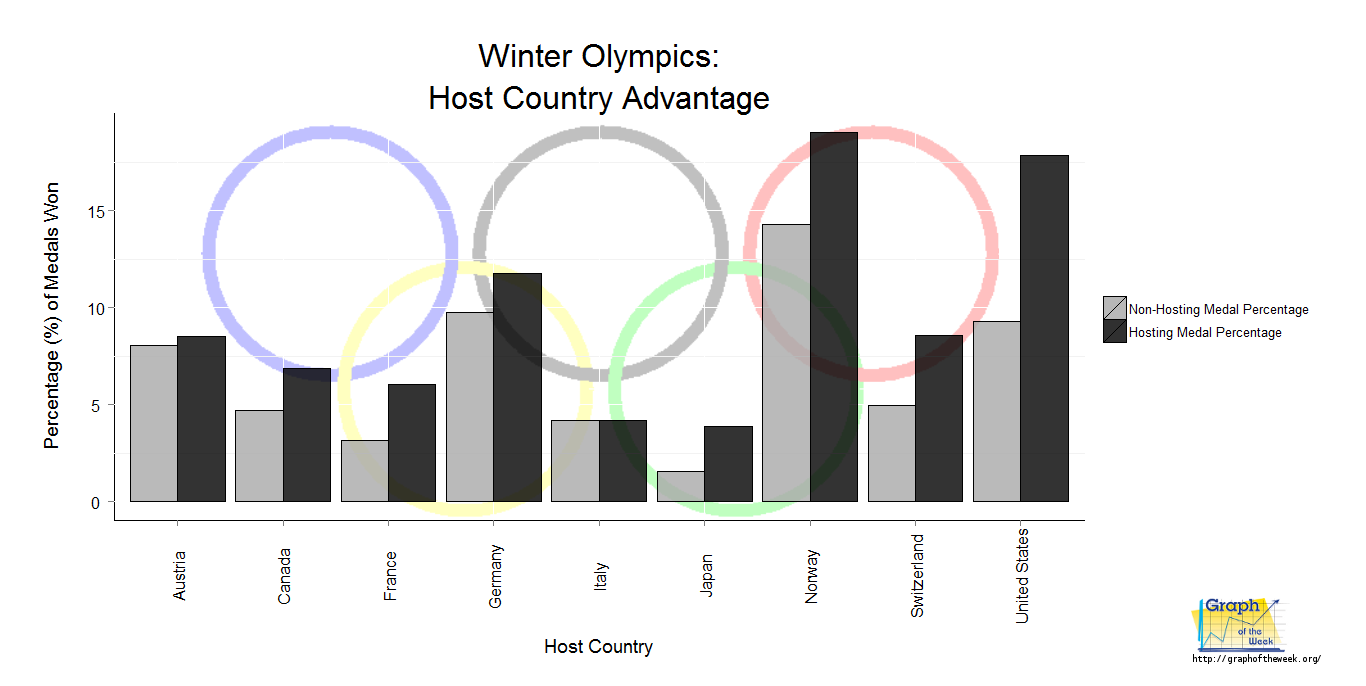
A couple of weeks ago, Graph of the Week published an article describing the significant improvement in medals won by the host country as opposed to how that country 'normally' performs when not hosting. We concluded that Great Britain (the host country) would end up with between 53 and 70 medals (roughly 1.5 - 2.0 times more than 'normal'). As it turns out, they won 65.

The Winter Olympics may not be until 2014, but why not make another prediction for the host country?  So, Russia, let's take a look at you and see what we can surmise.

Fact: Russia has never hosted the Winter Olympics - nor had the Soviet Union. That seems a bit odd seeing that the Russians usually do well in these games. There is probably another story lurking around there, but we'll let someone else field that one.

Thursday, August 9, 2012

2012 Summer Olympics: Home Court Advantage - How Will the Brits Perform?


olympics host country home cooking
The Olympics are a big deal on a global scale. How big? Perhaps Paula Radcliffe (an English long distance runner) said it best:
"I have achieved a lot and I'm grateful for that - I'm just a bit greedy because I want to add the Olympics. It's once every four years - everyone wants it and very few people get it."
Take that sentiment and factor in competing in the Olympics in your home country. Talk about intense!

Friends and Family Plan

What inspires an athlete to perform better in front of a home crowd? How is it possible to jump a little higher, throw a little harder or run a little faster when he/she would otherwise not do so? The graph above shows this effect using the host countries' medal percentage from all modern-era Summer Olympics. There is a sharp increase in the total number of medals won (as a percentage of all medals awarded) by the host country as opposed to when they are not hosting. It should be noted that some of the results are heavily skewed due to boycotts (which further increased the home countries medal percentage significantly) and other factors described later in this article.

The 'home court advantage' has been studied previously and is a well-known phenomenon. In fact, it appears to be present across all sports as noted by Harvard researcher Jeremy P. Jamieson, PhD, in the Journal of Applied Psychology:

"A significant advantage for home teams was observed across all conditions (Mp = .604); and time era, season length, game type, and sport moderated the effect."

Thursday, July 19, 2012

Health Care Costs - Part 3, "Why You Are Paying More"

yearly dollars awarded malpractice
Malpractice - A Booming Industry?

Perhaps authors Frank Sloan, Randall Bovbjerg and Penny Githens capture it best from their book Insuring Medical Malpractice:
"If aging Doctor Kildare were to return to medical practice today, having been in suspended animation since the early 1960s, he would find enormous changes in his malpractice insurance coverage. The first surprise is that the physician's malpractice coverage has become so important. No longer can he practice at his hospital without it. And much higher limits are needed to protect his practice and other assets against the financial risks of lawsuits."
This history of health insurance is a story of evolution, revealing ecological niches in the system allowing for the growth of malpractice lawyers and casualty insurers. In other words, doctors now have to protect themselves against financial ruin by purchasing malpractice insurance.

A quick glance at the above graph will quickly show that from 1990-2004 the dollar amounts awarded in malpractice cases rose significantly, with the largest gain coming in a five year period from 2000 - 2004. The publicity surrounding these astonishingly high payouts was intense, resulting in various forms of tort reform implementing caps on malpractice payouts in some states. Since then, the total amount awarded of medical malpractice claims have decreased.


Yet health care costs still continue to rise.


Wednesday, July 11, 2012

Health Care Costs - Part 2, "Unhealthy Things Not Related to the Problem"

Lighting Up

Way back in the day, folks believed that smoking was not only cool but also completely safe. As Marcel Danesi states in his book Of Cigarettes, High Heels, and Other Interesting Things, Second Edition: An Introduction to Semiotics (Semaphores and Signs):

"American society believed that smoking was not only highly fashionable, but that is also relieved tensions and even produced health benefits."
At least this explains why smoking was performed with such "unapologetic gusto" in those old movies. Alas, these poor souls knew not what awaited them later in life. Often there is a high price to be paid for fashion - sometimes in monetary terms, sometimes in emotional terms and unfortunately, sometimes in physical terms. Danesi goes on to point this out:
"However, epidemiologists started noticing around 1930 that lung cancer - rare before the twentieth century - had been increasing dramatically."
Due to the overwhelming evidence linking smoking and lung cancer, the U.S. imposed a ban on tobacco advertising on TV and Radio while also forcing manufacturers to put a warning label on the packages.

Thursday, July 5, 2012

Health Care Costs - Part 1, "The Problem"

yearly health care costs graph


The Problem

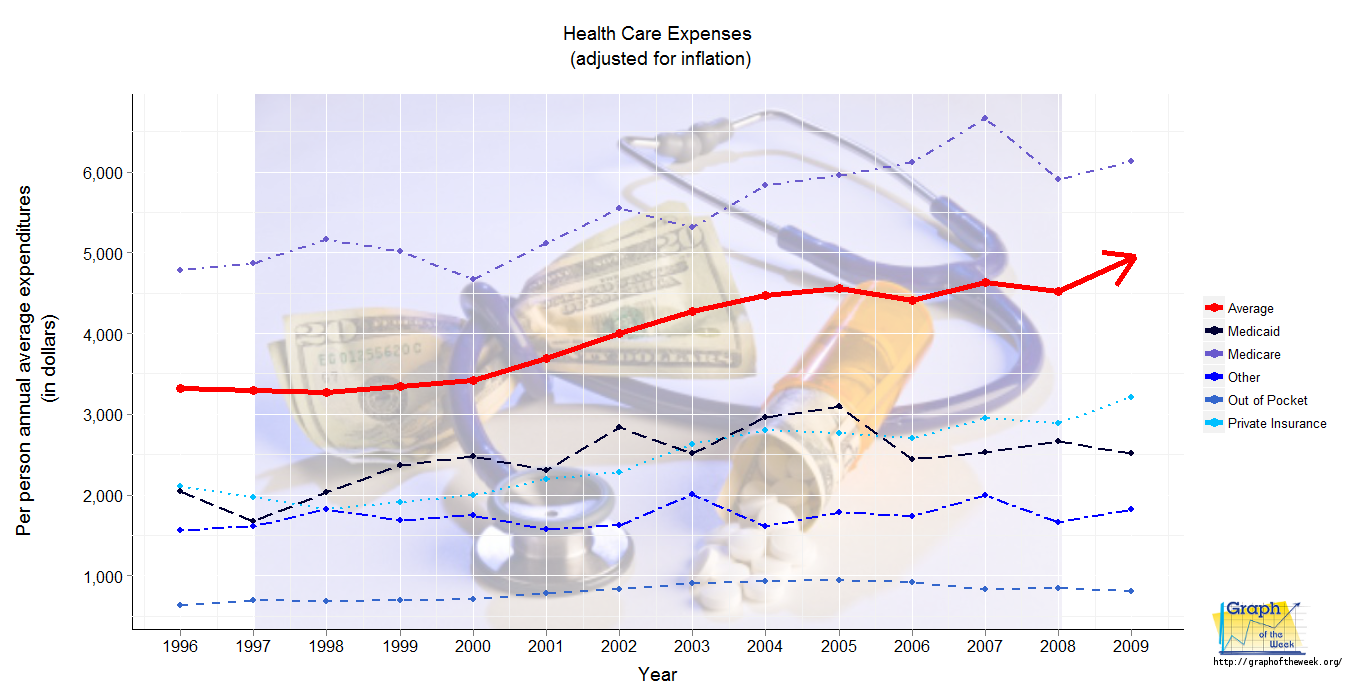
In the United States, health care costs have been going up for a number of years, even when adjusted for inflation. Not unlike a runaway freight train, this rampant inflation cannot continue indefinitely without crashing.

Health

What is 'health', anyway? According to Steven Jonas, MD, Raymond Goldsteen, DrPH, and Karen Goldsteen, PhD in their book An Introduction to the U.S. Health Care System, the World Health Organization (WHO) defined it in 1946:

"Health is a state of complete physical, mental and social well-being and not merely the absence of disease or infirmity."
Interesting. When is the last time any of us felt like this was the goal of health care in the U.S.? They go on to say:

"Indeed, the WHO definition is 'honored in repetition, rarely in application.'"
So, even when 'health' (as defined here) is only applied in a narrow scope, the costs are still increasing quickly - and outpacing inflation (otherwise the lines above would be flat).

Wednesday, June 20, 2012

Body Weight in the United States - Part 3, "Contributing Factors"

calorie intake by food group chart

Carbs

In Part 2 of this series, micro-nutrients were cited as a non-factor for weight gain. This is not the case with macro-nutrients (carbohydrates, fats, proteins, water). While fats, proteins and water are essential (without them you could not live), carbohydrates, on the other hand, don't appear to share this status. As Dr. Christian B. Allan and Dr. Wolfgang Lutz state in their book Life Without Bread: How a Low-Carbohydrate Diet Can Save Your Life:

"To our knowledge, there has never been an essential carbohydrate discovered. Every carbohydrate your body needs can be made from either protein or fat."

Wow - powerful words, indeed. This is not to say that carbohydrates do not add healthy value to our bodies (such as fiber); rather is puts their contributions into perspective. This makes looking at the above chart very disturbing as it shows we've been wolfing down carbs more and more for quite some time - a nutrient that we simply do not need in large quantities, much less ever increasing quantities.

Wednesday, June 13, 2012

Body Weight in the United States - Part 2, "Non Factors"

yearly alcohol consumption graph united states

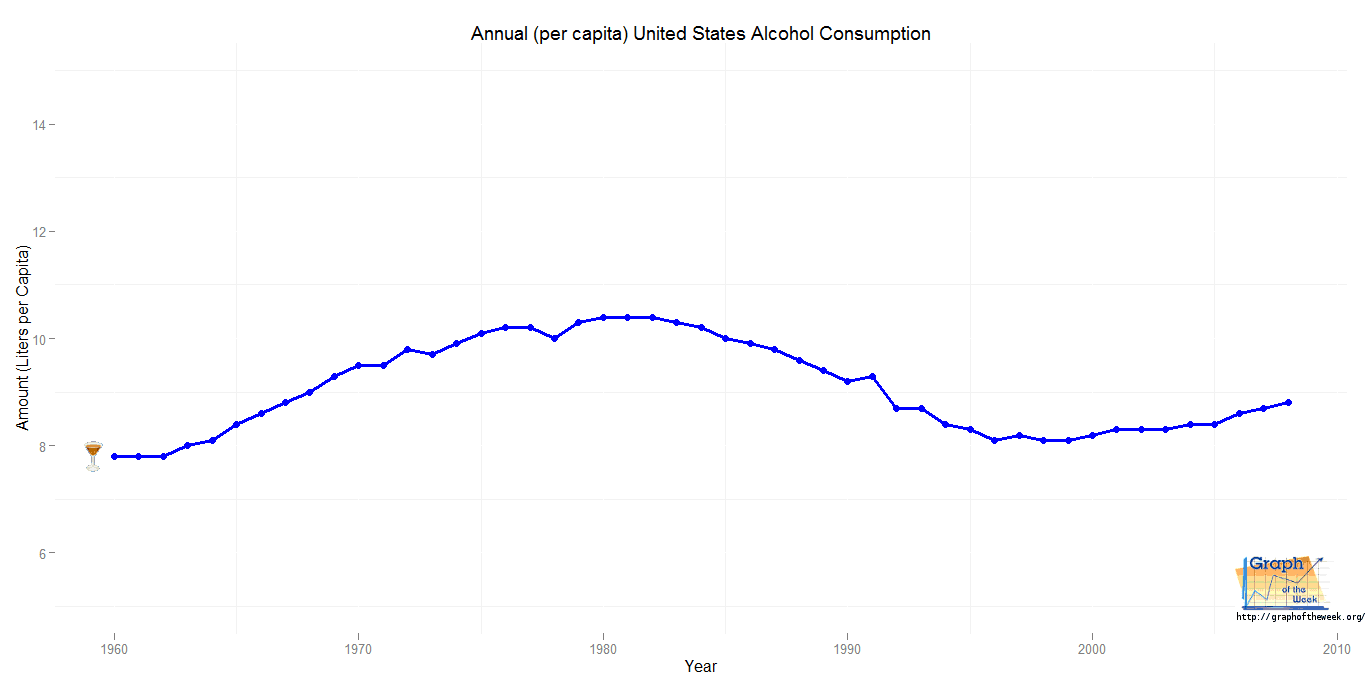
Sometimes the story isn't what is a trend, but rather what is not a trend. In this second installment about body weight in the U.S., listing what doesn't seem to be contributing factors will help narrow down what might actually be the problem(s).

Alcohol

"Stay busy, get plenty of exercise and don't drink too much. Then again, don't drink too little."
     - Herman "Jackrabbit" Smith-Johannsen

Sage advice from a person who lived to be 111 years old.


Stylify Your Blog